Follow the Money: A Plain-English Tour of the Federal Checkbook Washington Hopes You Never Read
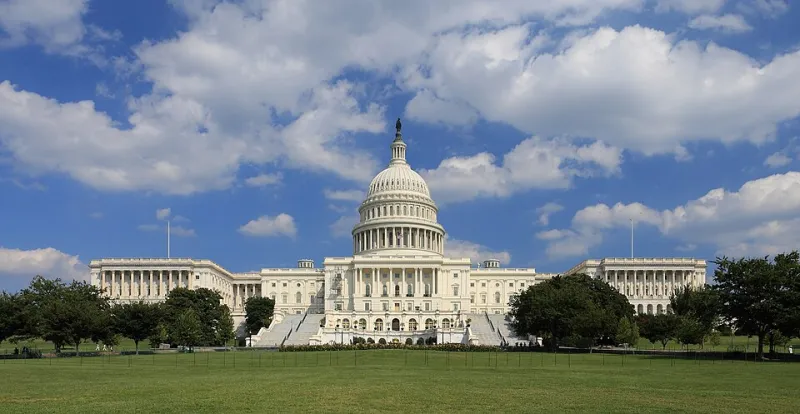
Photo: Martin Falbisoner, CC BY-SA 3.0, via Wikimedia Commons
Every April, Americans sit down with their tax returns, their receipts, and their sense of dread. They know precisely what they paid. Almost none of them know what they bought.
That asymmetry is not an accident. A budget is a moral document, and the federal budget is written in a language deliberately designed to resist scrutiny. Discretionary spending — the portion Congress must reauthorize annually — now exceeds $1.7 trillion, and when trust funds and mandatory programs are layered in, the total obligations of the federal government cross the $2 trillion mark with room to spare. Buried inside that figure are programs most citizens have never heard of, let alone voted for.
What a Trillion Actually Buys
Start with the categories everyone can name. National defense consumes roughly $800 billion, and whatever one thinks of specific procurement choices, the constitutional case for that spending is unambiguous. Beyond it sit the familiar domestic pillars: transportation, education, veterans' affairs, homeland security.
But the budget's real character lives in the fine print. Consider a sampling of the kind of line items that surface when anyone bothers to look: grant programs for international media training, multi-million-dollar studies on subjects ranging from shrimp treadmills to the social habits of barflies, regional development authorities that have outlived whatever crisis justified their creation, and administrative agencies whose budgets grow automatically, year after year, without a single hearing on whether they work.
None of these items individually matters much. That is precisely the point. A $40 million program is too small to make headlines and too small for a member of Congress to bother defending — and too small for the press to bother attacking. Multiply it by a few hundred, and you have the quiet engine of federal growth.
The Transparency Nobody Wants
Here is a modest proposal that should not be modest at all: every taxpayer should receive, alongside their tax bill, an itemized receipt. Not a pie chart with four blobs labeled "defense," "health," "interest," and "other" — but a genuine breakdown. You paid $14,000 in federal income tax this year. Here is what $14,000 funded, to the dollar where practicable.
Some on both sides of the aisle pay lip service to this idea. It has never happened, and one suspects the reason is simple: a citizen who can see that his tax bill funded $73 worth of a program he finds absurd is a citizen primed to make a phone call. Transparency is cheap. Accountability is expensive. Congress has historically preferred to fund the former in press releases and avoid the latter in appropriations.
The technology exists. The data exists — the Treasury's own monthly statements run to thousands of pages of detail. What is missing is the will, because the moment a receipt lands in thirty million mailboxes, the conversation about spending stops being abstract and becomes personal.
Where Bipartisan Cuts Actually Live
The standard objection is that cutting anything is impossible because every dollar has a constituency. The objection is half true. Every dollar has a constituency; most of them are small, and most of them do not vote on the issue.
There are cuts that polling consistently shows command support across party lines: consolidating duplicative federal grant programs, of which the Government Accountability Office has catalogued dozens overlapping in mission; ending subsidies to well-endowed corporations that hardly need taxpayer support to advertise during the Super Bowl; reclaiming unobligated balances from agencies that routinely fail their own financial audits — the Pentagon has famously never passed one, but neither have several civilian departments; and imposing sunset provisions on programs created for emergencies that ended decades ago.
None of this touches Social Security or Medicare, and it does not need to. A serious effort aimed merely at the unexamined residue of the discretionary budget — waste, duplication, and programs that survive purely because nobody reads the fine print — could recover tens of billions annually without touching a single benefit any American has earned.
An Electorate of Auditors
The deeper argument is cultural. Conservatism's fiscal case has grown stale when delivered as abstractions — deficits, debt-to-GDP ratios, projections for 2043. Voters cannot feel a projection. They can feel a receipt.
Imagine a political movement that made one promise above all others: you will always know where your money goes. That is not a technocratic proposal; it is a transfer of power. The entire architecture of federal spending depends on the taxpayer's ignorance of its details. Replace ignorance with an itemized bill, and the bargaining position of every taxpayer in the country changes overnight.
The Constitution vests the power of the purse in the people's representatives. It is long past time the people asked for an accounting — and got one.