If You Bought It, You Own It: The Farm Belt’s Repair Fight Comes of Age
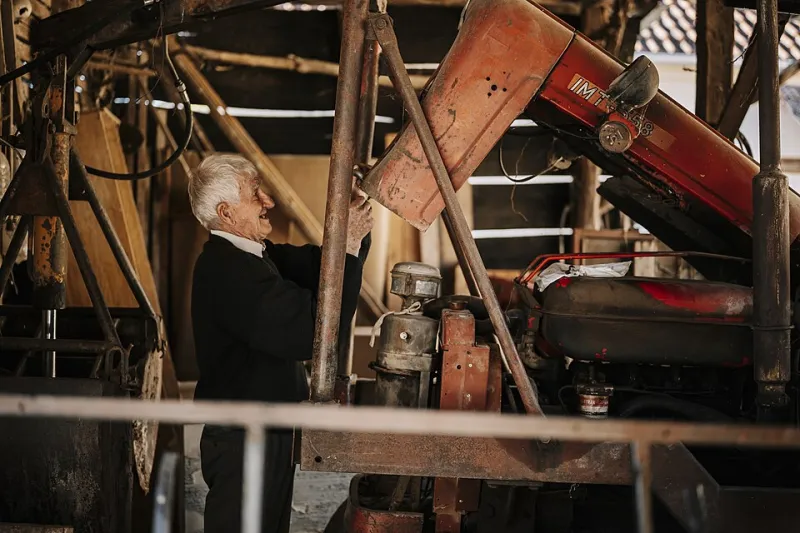
Photo: Shixart1985, CC BY 2.0, via Wikimedia Commons
The combine does not care about the calendar. When it breaks in the middle of harvest, the farmer has a narrow window to fix it before weather and markets take their cut. For generations, that meant a toolbox, a manual, and a neighbor who knew the machine. Today it can mean a laptop that will not talk to the equipment, a dealer ninety miles away, and a manufacturer that insists the owner does not have the right to repair what he bought.
That is the practical face of the right-to-repair fight. It is also, at bottom, a property-rights fight. If a person buys a machine, he should own it—not merely rent the use of it under terms set by the seller. The current arrangement in too much of American agriculture and small business is a conditional license dressed up as a deed.
Ownership Used to Mean Something
A tractor, a truck, or a combine is not a subscription. It is capital equipment, often bought with borrowed money and maintained on a schedule that has to survive mud, dust, and a short harvest window. Farmers have always repaired their own equipment. Independent shops have always served the countryside. That was not a loophole in the economy; it was a feature of it. Ownership meant the right to use, maintain, and improve what you had paid for.
The modern lockout changes that bargain. Software controls more of the machine. Diagnostic tools are restricted. Parts are paired to serial numbers. Repair information is treated as a trade secret even when the owner needs it to keep a machine running. The result is not a safer machine. It is a captive customer.
The Lockout Is a Business Model
Manufacturers defend these restrictions in the language of safety, emissions control, and intellectual property. Those concerns deserve answers, not a veto. A safety standard can be met by independent shops. Software can be secured without forbidding every owner from reading a fault code. Intellectual property can be protected without granting a manufacturer permanent control over the repair market for a product it has already sold.
Conservatives should be especially alert to the bait here. This is not a request for a new federal bureaucracy to inspect every wrench. It is a request that the law stop enforcing a private government over private property. When a manufacturer uses market power to foreclose independent repair, the proper response is not a subsidy or a mandate. It is clarity in contract and warranty law, scrutiny from antitrust enforcers, and state legislation that says ownership means something.
A Coalition That Makes Sense
The coalition pressing this issue is not a gathering of technophobes. It is farmers who cannot afford downtime, mechanics who cannot get diagnostic access, small-business owners who cannot wait weeks for a dealer, and free-market advocates who understand that monopoly service is not a free market. It is also, increasingly, conservative legislators who see the issue for what it is: a question of who controls property after the sale.
Massachusetts voters approved a motor-vehicle right-to-repair measure in 2020, and the fight has only widened since. Statehouses have taken up bills covering farm equipment, electronics, and power tools. Attorneys general have asked harder questions about repair restrictions. The Federal Trade Commission has signaled interest in the competitive harm that comes from repair lockouts. None of this is a federal takeover. It is a correction of a market failure that consumers did not create.
The Statehouse Is the Right Battleground
This is where conservatives should be at their strongest. Right-to-repair is a local-control issue, a property issue, and a small-business issue. It does not require Washington to redesign the American economy. It requires state legislatures to say plainly that a warranty cannot be voided merely because an owner or an independent shop did the work, that diagnostic information must be available on fair terms, and that manufacturers cannot use software to erase the ordinary incidents of ownership.
There is a legitimate debate about how far such laws should go. Safety systems, emissions controls, and cybersecurity are real concerns. But the burden should be on those who would restrict repair to show that the restriction is narrowly tailored and necessary—not merely convenient for the dealer network. A broad intellectual-property claim cannot become a general immunity from competition.
What Conservatives Should Demand
The conservative position is not complicated. If you buy it, you own it. Warranty terms should be transparent. Repair markets should be open. Manufacturers should compete on service rather than rely on lockouts. Antitrust enforcers should look closely when a dominant seller uses software and parts pairing to control an aftermarket. State lawmakers should protect the farmer with a wrench as surely as they protect the dealer with a contract.
None of this is radical. It is the old American assumption that property is worth defending. The farmer in the field is not asking for a favor. He is asking government to stop enforcing a private government over his own equipment. That is a request conservatives should understand—and answer.